
Curry Dyslexia Solutions provides students with the expert help they need to become confident readers.
We believe that fluent reading is essential to flourishing and that every child can become a confident reader–if provided with the right instruction. If your child is struggling with reading, it doesn’t mean they aren't capable—it just means they need the right tools for take-off.
We are here to help you find the solution.



About
My name is Alexa Young
Briefly introduce yourself and share something interesting with website visitors. Double click to edit the text.
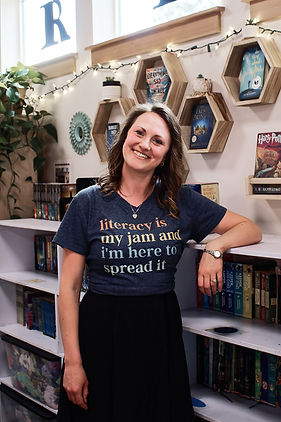
Macy Curry is a licensed teacher, dyslexia specialist, and owner of Curry Dyslexia Solutions. Nine years of teaching Language Arts in public, private, and charter schools gave Macy a passion for the power of reading–and a heart for those who struggled.
She founded Curry Dyslexia Solutions to reach students who fall through the cracks, the ones who need a different approach and more personalized help to master the skill of reading. Macy’s approach is characterized by compassion and expertise–acknowledging the anxiety and low self-esteem that often accompany reading challenges while also providing practical help to change a child’s academic trajectory forever.
Macy also works with parents and educators who are seeking solutions for their own students. Her knowledge of current science of reading research paired with her teaching experience, allows her to uniquely support, encourage, and provide relevant resources for those supporting developing readers.
A lifelong lover of language, Macy holds a Bachelor of Science in Elementary Education (K-8), a Bachelor of Arts in Foreign Language, and a Masters in Dyslexia Therapy. She is also a Certified Academic Language Practitioner (CALP), one of the highest levels of training for dyslexia specialists. Outside of reading therapy, Macy enjoys outdoor activities such as paddleboarding and hiking, spending time with her husband and her pup, Paddington, and, of course, reading.

FAQs
What is Dyslexia?
A common misconception is that dyslexia involves switching letters or seeing letters backwards. However, according to the International Dyslexia Association:
-
Dyslexia is a learning disability.
-
Symptoms are difficulties in word reading and/or spelling that involve accuracy, speed, or both.
-
Symptoms exist even after participating in reading instruction that is effective for other students.
-
Common underlying issues are deficits in phonological processing (processing the sounds of language) or morphological processing (processing the meaningful parts of words, such as prefixes, suffixes, and roots).
-
Secondary consequences of dyslexia are academic difficulties, reduced growth in language, knowledge, and writing, limited employment opportunities, and reduced psychological well-being.
I think my child may have dyslexia but I’m not sure. What should I do?
One great option is a Dyslexia Risk Assessment, a one-time consultation that informs you of the likelihood that your child has a reading disability. If a reading disability is indicated, you can then choose to pursue Reading Intervention or a formal dyslexia assessment (referrals provided).
Does my child have to be diagnosed with dyslexia to work with you?
No, your child does not need an official diagnosis to work with me. If your child is struggling, chances are they fall on the spectrum of dyslexia and reading therapy will help them. There is no need to delay reading support. If you would like to pursue an official diagnosis for your child at any point, I can assist you in the process and refer you to reliable resources. In addition, if in the course of our reading intervention I feel your child’s issues stem from an issue independent of a reading disability, I will inform you and help guide you to the proper resources.
My child is struggling in school but the teacher says it is just because he/she doesn’t pay attention or just doesn’t try hard enough. What should I do?
Children commonly have both ADD/ADHD and dyslexia. In addition, sometimes a reading disability makes reading so laborious for a child that their attention is quickly worn out, or it is easier to “goof off” than struggle through reading. If you feel your child is behind in reading, pursue reading intervention as well as considering support for attention deficits.
I’ve heard vision therapy, colored overlays, or certain fonts can help with dyslexia. Should I pursue those options?
Dyslexia is not a vision issue. Individuals with dyslexia do not have problems seeing letters clearly; the issue lies in the brain circuits that process the sounds and patterns of language. Vision therapy, colored overlays, and certain fonts will not cure dyslexia; individuals need research-based reading intervention to strengthen the parts of the brain that process language. However, sometimes individuals do have a vision issue along with dyslexia, such as an eye-tracking issue, that may benefit from an additional therapy in addition to dyslexia therapy.